Building Finland’s Semiconductor Talent journey
Finland’s semiconductor ecosystem is growing — but growth cannot happen without talent. Companies across the industry report an urgent need for skilled professionals. According to the Chips from the North strategy*, Finland will need 15,000 new semiconductor professionals by 2035.
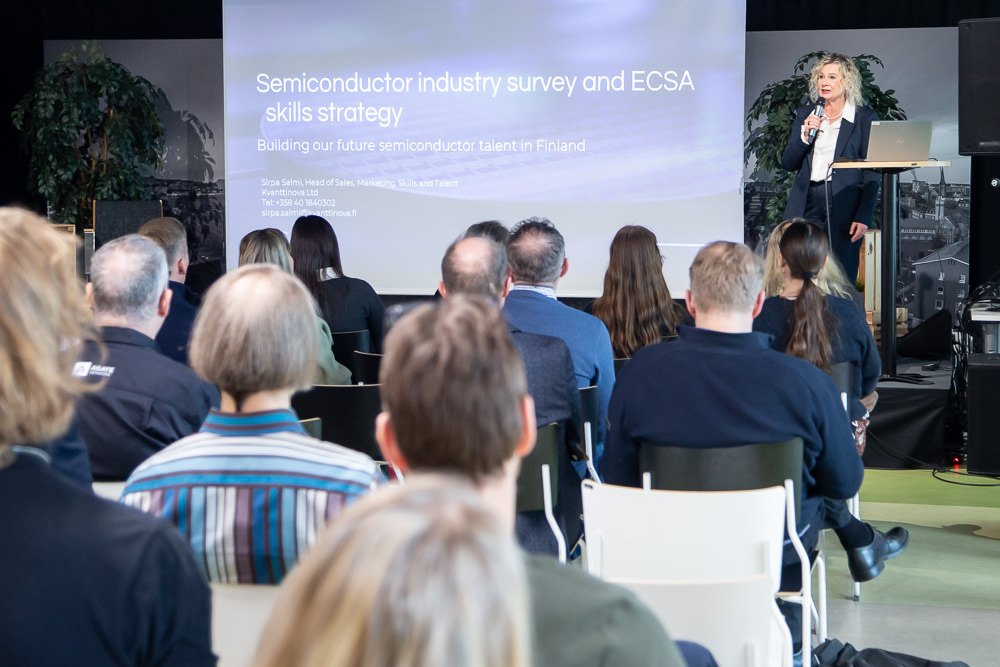
Sirpa Salmi presented the results of the expert survey at the Building Our Future Semiconductor Talents event.
Photo: Mirella Mellonmaa /International House Tampere
A recent workshop, Building Our Future Semiconductor Talents, held on 10.3.2026, brought together industry leaders, educational institutions, and ecosystem partners to address this critical challenge and explore opportunities for developing the talent pipeline.
Top talent needs and recognized challenges in the current talent journey
One of the clearest messages from the workshop discussions was that the semiconductor industry’s growth is increasingly constrained by access to experienced talent. While Finland has strong research capabilities and graduates entering the field, companies across the ecosystem highlighted an urgent need for specialized expertise and senior-level professionals who lead development, scale operations and mentor the next generation of engineers.
Companies consistently identified a shortage of senior-level experts, especially in:
- R&D and process development
- IC/semiconductor design
- ALD specialists
- Clean room operators and technicians
- Technical sales and business development with deep tech understanding
Finland has a strong junior base, but a critical lack of mentors and senior engineers is slowinggrowth.
At the same time, discussions highlighted another key bottleneck: the lack of practical, hands-on semiconductor training. While academic programs provide strong theoretical foundations, companies emphasized that graduates often lack opportunities to gain applied skills needed in semiconductor manufacturing and development environments.
Key issues include limited clean room access, shortage of qualified instructors and lack of capacity to train juniors in-house. Participants widely called for expanded clean room training pathways and joint industry–university specialist programs to strengthen the talent pipeline. Also a need for short courses and micro-credentials was noted by multiple participants.
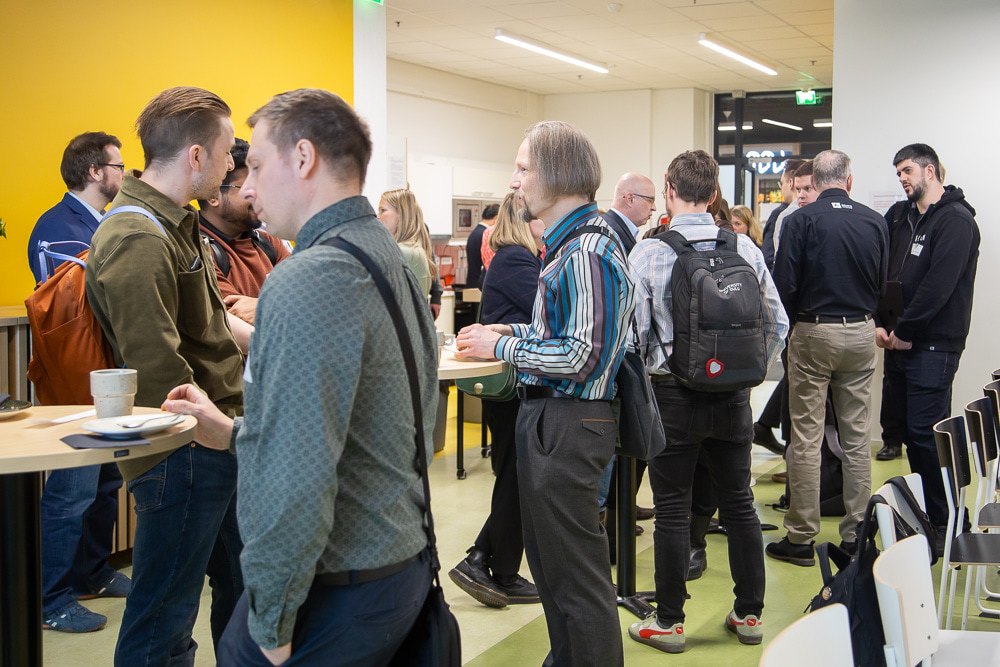
The event featured a wide range of interesting discussions and provided opportunities to network with various organizations. Photo: Mirella Mellonmaa /International House Tampere
Recruiting is time consuming and requires taking risks
In addition to the talent shortage, companies highlighted several practical challenges related to recruitment. Employers noted that finding the right candidates – especially for highly specialized roles – can be time-consuming, costly, and uncertain, particularly for smaller companies with limited recruitment resources.
It was reported that employers face high volumes of irrelevant applicants and difficulty in sourcing senior talent domestically. The discussions indicated that companies have poor visibility to public support services that could help in the recruitment process.
Retention and Integration
In addition to recruitment, retaining talent, especially international hires, is becoming a growing challenge. Companies noted that even when recruitment succeeds, long-term retention is not guaranteed.
Some recognized challenges in retention were:
- Limited social networks and integration channels
- Weak spouse employment support
- Fragmented relocation services
- Young hires leaving after 2–3 years
Suggested solutions include city-led buddy programs, stronger family support, and clearer onboarding journeys to help international professionals integrate and stay.
Could we find a possible solution from more innovative talent matching?
Participants also discussed new ways to complement traditional recruitment processes. In a highly specialized field like semiconductors, companies and candidates both benefit from opportunities to test mutual fit before committing.
Proposed approaches were:
- Hackathons and tryout campaigns
- AI-based motivation or personality assessments
- Informal networking events
- Publicly supported trial periods
These methods can reduce hiring risks and help companies identify suitable candidates earlier.
Next steps for Finland
Across the workshop discussions, several shared priorities emerged:
- Develop clean room training programs
- Create a unified “Talent Support Map” for recruitment and integration services
- Improve pre-screening for international recruitment events
- Launch short, industry-aligned courses
- Boost youth interest through early exposure and success stories
With coordinated action between industry, education providers, and public organizations, Finland can strengthen its semiconductor talent pipeline and support the continued growth of the ecosystem.
We at FiCCC and Kvanttinova will continue building the bridge between the industry and service providers and supporting the talent acquisition and retention with actions both on shorter and longer scale.
Sirpa Salmi
WP6 leader, Skills & Talent
The text was originally published on FiCCC website

Sirpa Salmi
Head of Sales, Marketing, Skills and Talent
Insights
Read more
 Event
Event
Nordic Chip Summit 2026
Nordic Chip Summit 2026, 7–8 September, brings together semiconductor, photonics and quantum technology leaders, researchers, investors, policymakers, and ecosystem builders from across the Nordics and Europe.
 News
News
Reflections from the Nordic Chip Summit 2025
Why is it important to gather together in events and share thoughts with peers? Jussi Tuovinen reflects his thoughts on organising Nordic Chip Summit 2025.
 News
News
Europe’s Digital Future with Finnish Flavour – Some thoughts aroused by the Sitra Policy Brief
Sitra, Technology Industries of Finland and VTT published a joint policy brief on the critical digital technologies and Europe’s position in them, now and in the future.